One of the privileges I will never take for granted was the chance to train at San Diego State during the off-season with a group of incredibly talented baseball players.
It was a collection of guys from different professional organizations and colleges, many of whom had attended San Diego State. From time to time, established big leaguers were around, guys like Jacque Jones and Prince Fielder. We were all there for the same reason: to get better.
Tony Gwynn Sr., arguably the greatest hitter of the modern era, was the head coach at San Diego State during those years. He would often spend time around us, sharing stories, answering questions, and offering his thoughts on hitting. For someone who had reached the absolute highest level of skill in his profession, his humility was remarkable.
I remember one time somebody asked him a question about hitting. Rather than offer his own opinion, he said, “I don't know. What do you think?” and turned the question toward me.
I still think about that moment.
Here was one of the greatest hitters in the history of baseball, a man who had forgotten more about hitting than most of us would ever learn, asking for my opinion. I don't know whether it was respect, kindness, or simply his natural humility, but it said an awful lot about the quality of the man.
Behind the talent, a plan
Beyond his character, something else about Tony Gwynn left an impression on me. It was his approach to the game, particularly the process he believed in.
We tend to look at people who achieve extraordinary things and focus on their natural ability. Tony was certainly an incredible athlete, a multisport athlete who could have succeeded in more than one profession. But what I came to appreciate was that behind all that talent was a plan. A blueprint he believed in and returned to over and over again.
He knew what he wanted to accomplish with a baseball. He knew his strengths and weaknesses, and through years of experience, he had built a process for becoming the hitter he wanted to be.
Tony Robbins has a saying: “Where focus goes, energy flows.”
I think that captures something important about what I learned from Tony Gwynn. Before you can build a plan, you have to know what you are trying to accomplish. You need an aim, a target, something you are working toward.
Nine spots, one Wiffle ball
For Tony, that process included a remarkably simple hitting routine.
It has been years, so I may be getting some of the details wrong, but this is how I remember it.
There is a batting tee company called Tanner Tee, and as I remember it, Tony had a customized version that sat extremely low to the ground. We would begin with a Wiffle ball on the far outside front corner of home plate, sometimes only eight inches or so off the ground.
If you have played baseball, you know how hard that pitch is to handle.
The idea, at least as I understood it, was that if you could keep your hands working and hold your bat through the hitting zone on a pitch that low and away, especially with the ball out in front, you would build the ability to handle just about anything else in the strike zone.
Go back and watch Tony Gwynn's at-bats. Nobody was better at getting fooled by a pitch, looking completely off balance, and somehow keeping his hands and barrel in the zone long enough to flip a ball into the outfield for a base hit.
The routine was methodical. Start with the ball low and away, out front. Then move it back to the middle of the outside corner, then the deep outside corner. Next, the middle of the plate, again front to middle to deep. Finally, the inside part of the plate, same progression.
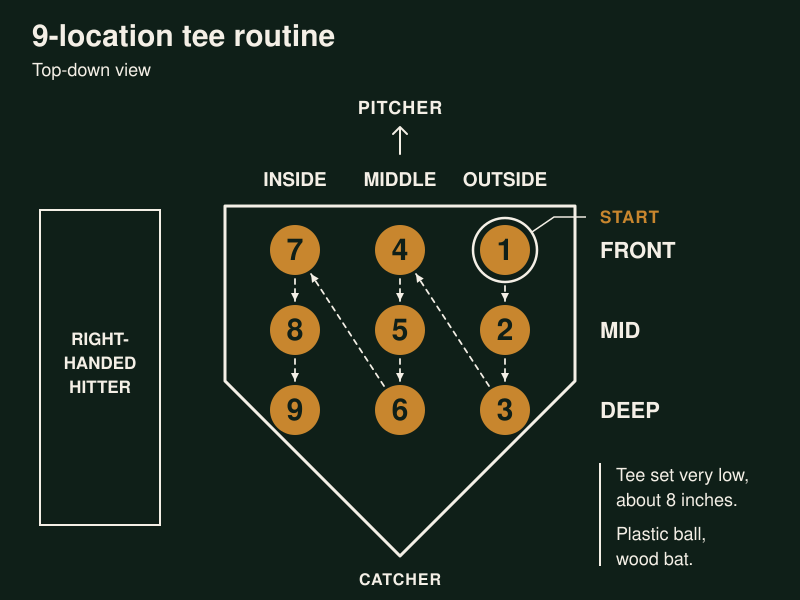
Nine locations, each with a purpose.
And we did it with Wiffle balls and wood bats.
If you have ever tried hitting a Wiffle ball with a wood bat, you know why that matters. The Wiffle ball does not lie. Your bat path, the quality of contact, your ability to keep the barrel in the zone, everything shows. You get immediate feedback on what you are doing well and, more importantly, what you are doing poorly.
A different kind of hard
By the time I was introduced to this routine, I had already spent years playing professional baseball. I always considered myself a hard worker, and I think my teammates and coaches would have agreed.
But this was a different kind of work.
This was not hitting until your hands bled, running until you nearly passed out, or lifting until you could not lift anymore. Those things I understood. They were physically hard, but in some ways, they were easier.
This was tedious.
One swing at a time, trying to make each rep a little better than the last. Ten swings, twenty swings, sometimes more, all while concentrating on the smallest details.
It was almost like meditation.
Think about what happens when you sit quietly and try to meditate. Suddenly you are face to face with everything your mind would rather avoid. Your distractions, impatience, and inability to stay focused become impossible to ignore.
That is what this routine felt like.
You could not simply swing harder or work faster. You had to see what you were doing wrong, accept it, and adjust. Then do it again.
I can admit that when nobody was holding me to it, this was often the work I wanted to skip.
Not because I did not understand its value. I knew exactly why we were doing it. It was mentally hard, and there were a hundred other things I would rather have done.
Marginal gains
Years later, when I read about the British cycling team's philosophy of the accumulation of marginal gains, I immediately thought about Tony Gwynn.
The idea was simple. Rather than chase one enormous improvement, the team went after small improvements across nearly every part of performance. Training, equipment, nutrition, recovery, sleep. Improve enough small things by one percent, and eventually those improvements stack up.
I thought about that little batting tee.
I thought about how much attention we gave to something that looked so insignificant. One Wiffle ball, one swing, one adjustment.
And I thought about how easy it had been to convince myself the work was not necessary.
Incidentally, the season after training at San Diego State turned out to be the best of my professional career, and I earned my first All-Star selection. Looking back, I don't think that was a coincidence. I also know one season proves nothing on its own.
The lesson was not simply about working harder. It was about knowing what you are trying to accomplish and having the discipline to follow a process that moves you closer to it, especially when the process is uncomfortable.
What does greatness look like?
These are lessons I find myself trying to pass along to my kids.
Not just in sports, but in life.
I was talking with my daughter about her vision board. I asked her what she wanted to put on it.
She told me, “I want to practice more softball.”
I said, “Well, anyone can practice more softball. That doesn't take a vision. Why do you want to practice more?”
She said, “Because I want to be great at softball.”
So I asked her another question.
“What does greatness look like?”
She thought about it and said, “Me celebrating after I hit a home run in the championship.”
There it was.
That was her vision.
She could see herself celebrating, surrounded by her teammates, having delivered in a moment that mattered.
Practicing more softball was not the vision. It was one of the things she would need to do along the way.
Between where she stood that day and the moment she imagined were thousands upon thousands of chances to move closer. Practices, games, reps, failures, adjustments, and decisions about what to do when things got hard.
And that is where I think so many of us get lost.
We confuse the process with the destination. Or worse, we go through the motions of a process without ever deciding where we are trying to go.
We work hard. We stay busy. We fill our days with activity. But how often do we stop and ask whether the things we are doing are actually moving us toward what we want?
The windshield, not the mirror
When you set a clear goal, you also create the chance to see the distance between where you are and where you want to be.
Sometimes that is uncomfortable.
Sometimes you don't like what you see.
It is no different from standing at that low tee with a Wiffle ball, making a terrible swing, and realizing you still have a long way to go.
But there is something valuable in being able to see your shortcomings without letting them define you.
You can admit where you are without losing sight of where you are headed.
You can recalibrate.
Instead of staring in the rearview mirror at where you have been, you can look through the windshield toward where you are going.
I think that is part of what Ryan Holiday is getting at in The Obstacle Is the Way. The uncomfortable work we keep finding reasons to avoid is often the very work standing between us and what we are trying to do.
Of course, not everything hard is worthwhile. But when you know something is necessary, when you know it moves you closer to a goal that matters, you have to see the excuses for what they are.
There will always be a million reasons not to do the hard thing.
The reason to do it anyway has to be stronger.
And that is why the vision matters.
It gives purpose to the process.
It is what makes you return to that low tee, even when nobody is watching.
Postscript: A night in June
This past June, I got to see something that brought this lesson full circle.
My daughter was playing in an All-Star softball tournament, and her team had already won its previous game in dramatic fashion, coming from behind in their final at-bat.
The next night, they found themselves in another battle.
They took an early lead, but their opponent was a talented, well-coached team that battled back and built a three-run lead.
Our girls kept fighting.
Their pitcher and catcher worked together to keep the game close, the defense made several outstanding plays, and even with a few things not going their way, the team never seemed to lose its belief that it could come back.
Bottom of the final inning. Down three.
Three outs left.
One last chance.
A walk, a hit, and another big hit brought them within a run. Suddenly, after being on the edge of elimination, they had the bases loaded with two outs.
And my daughter was coming to the plate.
I couldn't help but think about that vision board conversation.
The picture she described to me was herself celebrating after hitting a home run in a championship game.
This was not a championship game, and she did not need a home run.
She needed a hit.
With two outs and the game on the line, she lined a single into left field that scored two runs and won the game.
For the second night in a row, her team won in its final at-bat.
They went on to finish as runners-up in the state tournament, an incredible run for a group of young girls who had worked so hard together.
I think about that night often.
Not because I believe a vision board guarantees a result. Baseball and softball do not work that way. You can do everything right and still make an out. You can prepare for months and have the ball find somebody's glove.
And I would never suggest one player's hit was responsible for the team's success. Without the pitching, the defense, and the at-bats that came before hers, she never would have had that chance.
But there is something worth appreciating in the relationship between the picture she had in her mind and the moment she eventually lived.
She had not imagined a single into left field in a game before the championship. She had imagined celebrating because she delivered for her team when it mattered.
And on that June evening, she got to feel exactly that.
It reminded me that the vision does not have to predict exactly how things unfold. Its job is to give us something meaningful to work toward.
We still have to do the work. We still have to deal with failure, disappointment, and all the moments when things do not go to plan.
And even then, there is no guarantee we get exactly what we set out to get.
But without an aim, what are we working toward?
I keep coming back to that question, not just as a parent, but in my own life.
There are plenty of things I know I should be doing that I find reasons to avoid. Things that take patience, concentration, and an uncomfortable amount of honesty with myself.
I still have my own version of that low tee.
And I suspect I always will.
The challenge is to remember why I walked up to it in the first place.
Where this fits for your players
The low tee is an adult routine. Solo, tedious, effortful work with instant feedback is close to what researchers call deliberate practice, and that kind of work is tied to adult expertise (Ericsson and colleagues). For younger kids, the research on athlete histories points the other way: lots of play and many sports early, with focused practice growing in the teen years (Côté).
Two pieces carry down to any age:
- Honest feedback. The Wiffle ball told us the truth on every swing. A target does the same for kids. See Hang a Hoop.
- An aim they picked. Ask what great looks like to them, then let practice be one of the roads there. Specific goals tend to guide effort better than “do your best” (Locke and Latham), mostly shown in adults.
Guidelines & sources this note follows
- Ericsson, K. A., Krampe, R. T., and Tesch-Römer, C. (1993). The role of deliberate practice in the acquisition of expert performance. Psychological Review. Effortful, feedback-rich practice that is not inherently enjoyable.
- Macnamara, B. N., Hambrick, D. Z., and Oswald, F. L. (2014). Deliberate practice and performance, a meta-analysis. Psychological Science. Practice matters, but explains less of the gap between performers than once claimed.
- Côté, J. Developmental Model of Sport Participation. Deliberate play and sampling early, more deliberate practice later. Mostly retrospective evidence.
- Salmoni, A. W., Schmidt, R. A., and Walter, C. B. (1984). Knowledge of results and motor learning.
- Locke, E. A., and Latham, G. P. (2002). Building a practically useful theory of goal setting and task motivation. American Psychologist.
- British Cycling, “aggregation of marginal gains.” Coaching philosophy popularized by Dave Brailsford. Widely told, mostly anecdotal. Not a tested study.
- BallNine (2020). “Stay Hitting, My Friends.” Describes Gwynn hitting plastic, hole-filled balls off a tee he moved inside, outside, and middle. The exact nine-spot order here is from memory.
- Holiday, R. (2014). The Obstacle Is the Way. Philosophy, not research.
- Robbins, T. “Where focus goes, energy flows.” A saying, not a finding.
Note on certainty: this is a personal story. The tee routine is told from memory; public accounts confirm the tee and plastic balls, not the exact order. One great season and one big hit illustrate the point; they do not prove the routine or the vision board caused anything.